

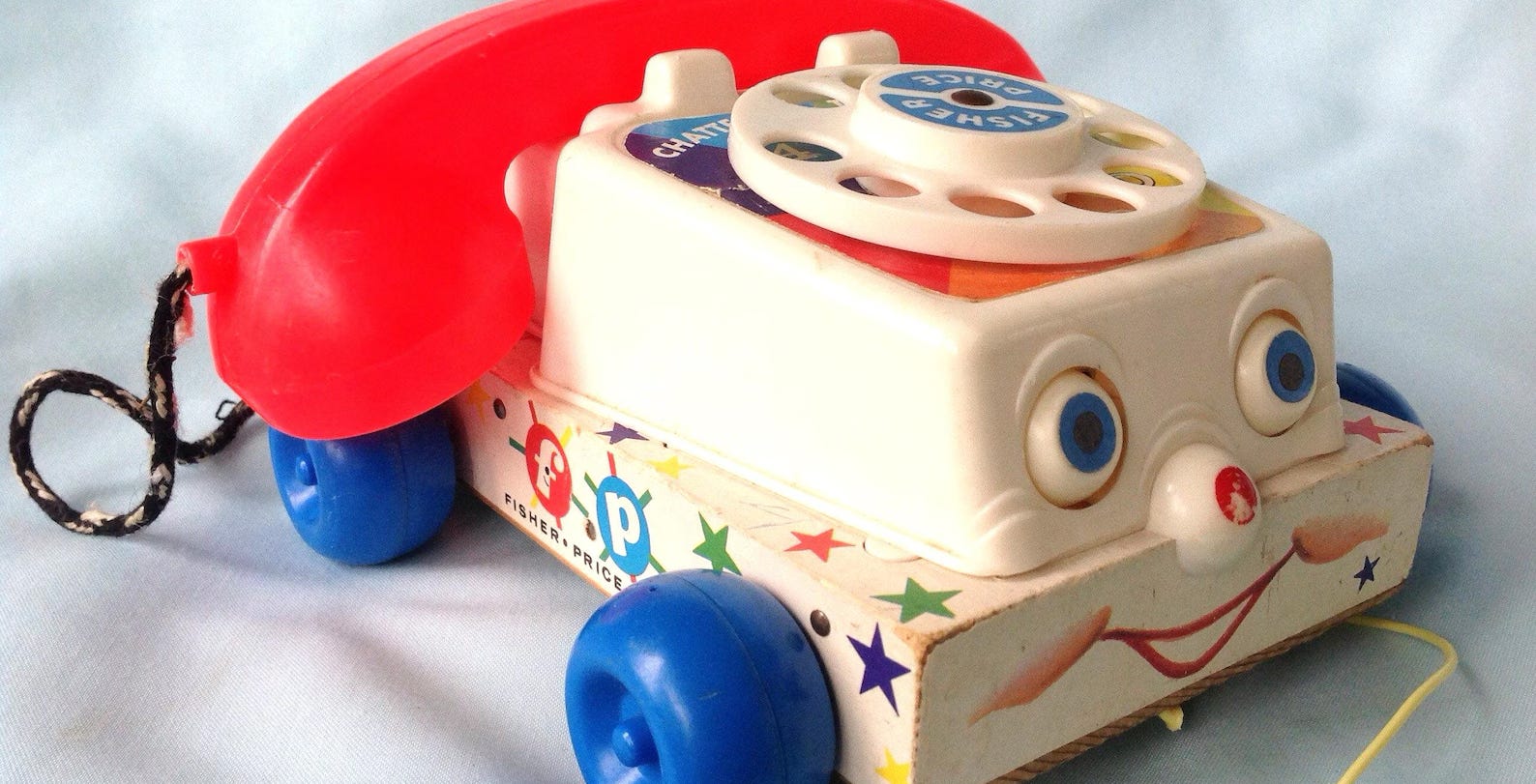
The infantilizing power of modern digital media is never so fully on display as when we try to resist it. In a new column, the New York Times opinion editor Meher Ahmad divulges her strategy for moderating her social media use. It’s quite involved:
I’ve removed all my social media apps — Instagram, Twitter, TikTok — and moved them onto an old iPhone I had lying around my house. I dubbed this phone my Scroll Phone. I designated a single spot in my home where I could use it: a stripy armchair in my living room, which I have now anointed the Scrolly Chair. . . .
The Scrolly Chair exists so that I don’t end up doing exactly what I did when my Actual Phone was also my Scroll Phone: eating dinner with my Scroll Phone, watching TV with my Scroll Phone, sitting on the toilet with my Scroll Phone. . . . If I’m on the Scroll Phone, I must be on the Scrolly Chair. I even bought a phone stand shaped like a little piggy for the Scroll Phone to keep it on my shelf, a way to remind myself of what I’m doing when I pick it up: gobbling up social media like a pig at the trough.
To curb her phone habit, Ahmad has to treat herself like an unruly toddler: assigning silly proper names to inanimate objects, buying a phone stand in the form of “a little piggy,” and designating a “stripy armchair” as a time-out zone for behavior-modification purposes. I wonder if she streams the Raffi Essentials playlist when she’s on her Scrolly Chair.
Writing how-to books and articles on breaking phone addictions has been a thriving cottage industry for at least a quarter century — ever since the BlackBerry was dubbed the CrackBerry. The Times alone has published dozens of pieces on the topic. A quick search reveals that, over just the last two years, these headlines have appeared in the paper:
“How to Break Free from Your Phone”
“Your Best Tips for Cutting Screen Time”
“Struggling with Phone Addiction? Try These Remedies.”
“How to Spend Less Time on Social Media (or Leave It Altogether)”
“How to Have a Healthier Relationship with Your Phone”
“Some ‘Brick’ It. Others Chain It to the Wall”
“Hanging Up”
“Do You Wish You Could Break Free from Your Phone?”
“Everything You Need to Break Up with Your Phone, from Free Tricks to Phone Safes”
“I Killed Color on My Phone. The Result Shocked Me.”
“They Grew Up with Smartphones. This Is How They Live without Them.”
“One Hour. No Phones. A New Way to Socialize for Gen Z.”
“Need a Break from Your Phone? These Books Can Help.”
“Is There Life after Smartphones?”
I hate to be a cynic, but I’m guessing the main reason for the proliferation of these sorts of articles is that they’re algorithmic catnip. They’re symptoms of the illness they seek to cure. We’re addicted to reading about our addiction to phones. If the pieces have a therapeutic value, it probably lies less in helping people gain control over media than in renewing a reassuring fantasy of such control.
But the articles and books also offer a striking portrait, in a sort of photo-negative style, of just how profoundly the technology has reshaped how we live. “What is the compelling urgency of the machine that it can so intrude itself into the very stuff out of which man builds his world?” asked the computer scientist Joseph Weizenbaum — the inventor of the Eliza chatbot — in his 1976 book Computer Power and Human Reason. Meher Ahmad’s rebuilding of her world to accommodate her phone habit may seem a trivial expression of Weizenbaum’s point, but in the Scroll Phone and the Scrolly Chair, and in that piggy-shaped phone stand, we see, in poignant detail, the machine’s intrusion into the most intimate corners of our lives. We’re its children now.
The extent to which one finds oneself disoriented when an object is removed is equal to how much one’s identity has merged with that object.
I'm a long-time fan, Nicholas, but I disagree with your premise. We are infantilizing ourselves. Putting the blame on "the power of modern digital media" just illustrates the problem. I have two husky-shepherd rescues. The most recent rescue has no impulse control and falls apart when she doesn't immediately get what she wants. Her older brother, who has lived with us for five years, waits patiently for food, for walks, for me to come home from an errand. The newest addition to our family, is learning. Humans can learn to put their phones down too, without being overly dramatic about it.