

Today’s Sunday Rerun is the epilogue to The Big Switch, my 2008 book on cloud computing and its consequences (and electrification and its consequences). This closing bit looks at the way humanity’s sense of progress hinges on generational turnover—on death, to be blunt. It’s a subject that’s almost never discussed, but I hope to explore it further this year.
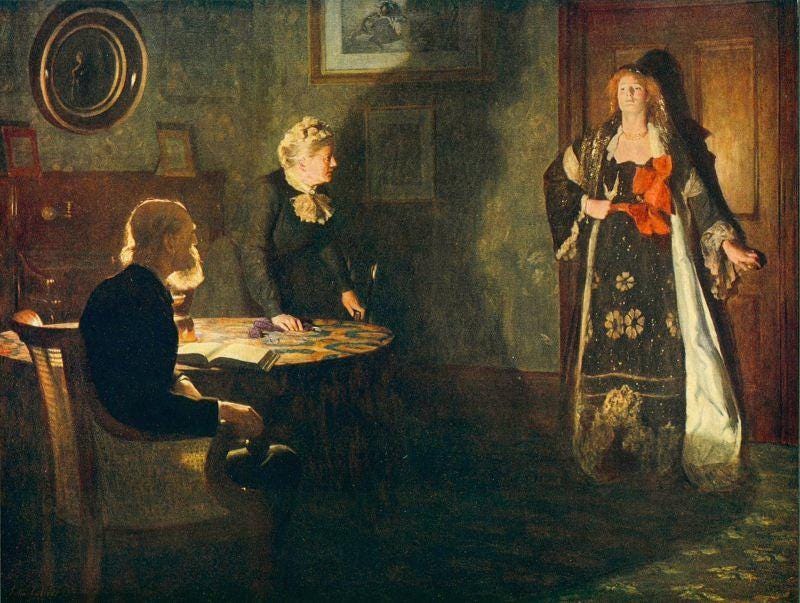
One of man’s greatest inventions was also one of his most modest: the wick. We don’t know who first realized, many thousands of years ago, that fire could be isolated at the tip of a twisted piece of cloth and steadily fed, through capillary action, by a reservoir of wax or oil, but the discovery was, as Wolfgang Schivelbusch writes in Disenchanted Night, “as revolutionary in the development of artificial lighting as the wheel in the history of transport.” The wick tamed fire, allowing it to be used with a precision and an efficiency far beyond what was possible with a wooden torch or a bundle of twigs. In the process, it helped domesticate us as well. It’s hard to imagine civilization progressing to where it is today by torchlight.
The wick also proved an amazingly hardy creation. It remained the dominant lighting technology all the way to the nineteenth century, when it was replaced first by the wickless gas lamp and then, more decisively, by Edison’s electricity-fueled incandescent bulb with its glowing metal filament. Cleaner, safer, and even more efficient than the flame it replaced, the light bulb was welcomed into homes and offices around the world. But along with its many practical benefits, electric light also brought subtle and unexpected changes to the way people lived. The fireplace, the candle, and the oil lamp had always been focal points of households. Fire was, as Schivelbusch puts it, “the soul of the house.” Families would in the evening gather in a central room, drawn by the flickering flame, to chat about the day’s events or otherwise pass time together. Electric light, together with central heat, dissolved that long tradition. Family members began to spend more time in different rooms in the evening, studying or reading or working alone. Each person gained more privacy, and a greater sense of autonomy, but the cohesion of the family weakened.
Cold and steady, electric light lacked the allure of the flame. It was not mesmerizing or soothing but strictly functional. It turned light into an industrial commodity. A German diarist in 1944, forced to use candles instead of lightbulbs during nightly air raids, was struck by the difference. “We have noticed,” he wrote, “in the ‘weaker’ light of the candle, objects have a different, a much more marked profile — it gives them a quality of ‘reality.’” This quality, he continued, “is lost in electric light: objects (seemingly) appear much more clearly, but in reality it flattens them. Electric light imparts too much brightness and thus things lose body, outline, substance — in short, their essence.”
We’re still attracted to a flame at the end of a wick. We light candles to set a romantic or a calming mood, to mark a special occasion. We buy ornamental lamps that are crafted to look like candles or candleholders, with bulbs shaped as stylized flames. But we can no longer know what it was like when fire was the source of all light. The number of people who remember life before the arrival of Edison’s bulb has dwindled to just a few, and when they go they’ll take with them all remaining memory of that earlier, pre-electric world. The same will happen, sometime toward the end of this century, with the memory of the world that existed before the computer and the Internet became commonplace. We’ll be the ones who bear it away.
All technological change is generational change. The full power and consequence of a new technology are unleashed only when those who have grown up with it become adults and begin to push their outdated parents to the margins. As the older generations die, they take with them their knowledge of what was lost when the new technology arrived. Only the sense of what was gained remains. It’s in this way that progress covers its tracks, perpetually refreshing the illusion that where we are is where we were meant to be.
Once spent a year living in a mountain community with no electricity...the quality of light you describe so well completely resonates. In particular I remember the sense that people's countenance were like Van Gogh portraits....so full of life and depth.
One other thing was how altered was my daily routine , being so dominated by the rising and setting of the sun despite oil lanterns...
When I moved into my apartment on the Upper West Side, the lights were on, so it didn't occur to me that I'd have to call Con Ed and set myself up. A week later I came home and they were off. Problem was, now a holiday weekend, then a two-day Jewish holiday got in the way of the Con Ed guys getting into the basement to set me up because you could only get into the basement through the kosher pizza place on the ground floor. Thus for more than a week I lived by candlelight. I got so used to it, in fact, that when my brother came to see my new apartment, he wondered why I was living in the dark and I didn't know what he'd meant, I'd gotten so used so used to it. It was lovely.
Years later, I've lost power several times in NJ due to storms and other grid problems. Now I have flashlights, but it's not the same.